What to Document After a Workplace Incident to Protect Your Public Liability Claim
At a glance
Record the date, time, location and circumstances of an incident while the details are still fresh.
Photographs, video and CCTV can preserve evidence of site conditions before anything changes.
Witness accounts and factual records of reported injury or property damage can provide important context.
Cleaning, maintenance, servicing and work records may help establish what happened before the incident.
Keep subsequent communications and provide relevant documentation promptly when notifying your insurer.
A client visits your workspace and trips over a cable. At another job, you accidentally damage equipment while working at a client’s premises. If someone has been injured, the priority is to ensure they receive appropriate medical attention and to address any immediate safety risks. Once those immediate needs have been dealt with, what you record about the incident can affect how any resulting claim is assessed.
If the incident later develops into a Public Liability claim, the circumstances may no longer be easy to recall. The area may have been cleaned, equipment moved, witnesses may be harder to contact and CCTV footage may no longer be available.
A clear record gives your insurer factual information about what happened and the evidence available. It does not establish fault or guarantee cover.
Here are the key details, evidence, business records and communications to document after an incident.
Record the Core Incident Details Straight Away
Create a written account while the events are still fresh. Record the exact date, time and specific location. Identify everyone directly involved, as well as any employees or contractors who witnessed or responded to the incident.
Describe what happened chronologically and stick to observable facts. Include what was happening immediately beforehand and any relevant conditions, such as poor lighting, wet flooring, repair work, heavy foot traffic or weather.
Avoid conclusions about responsibility. An incident report should record what happened, not determine liability. If your business uses an incident report form or register, complete it promptly and retain the original record.
Photograph the Incident Area and Surrounding Conditions
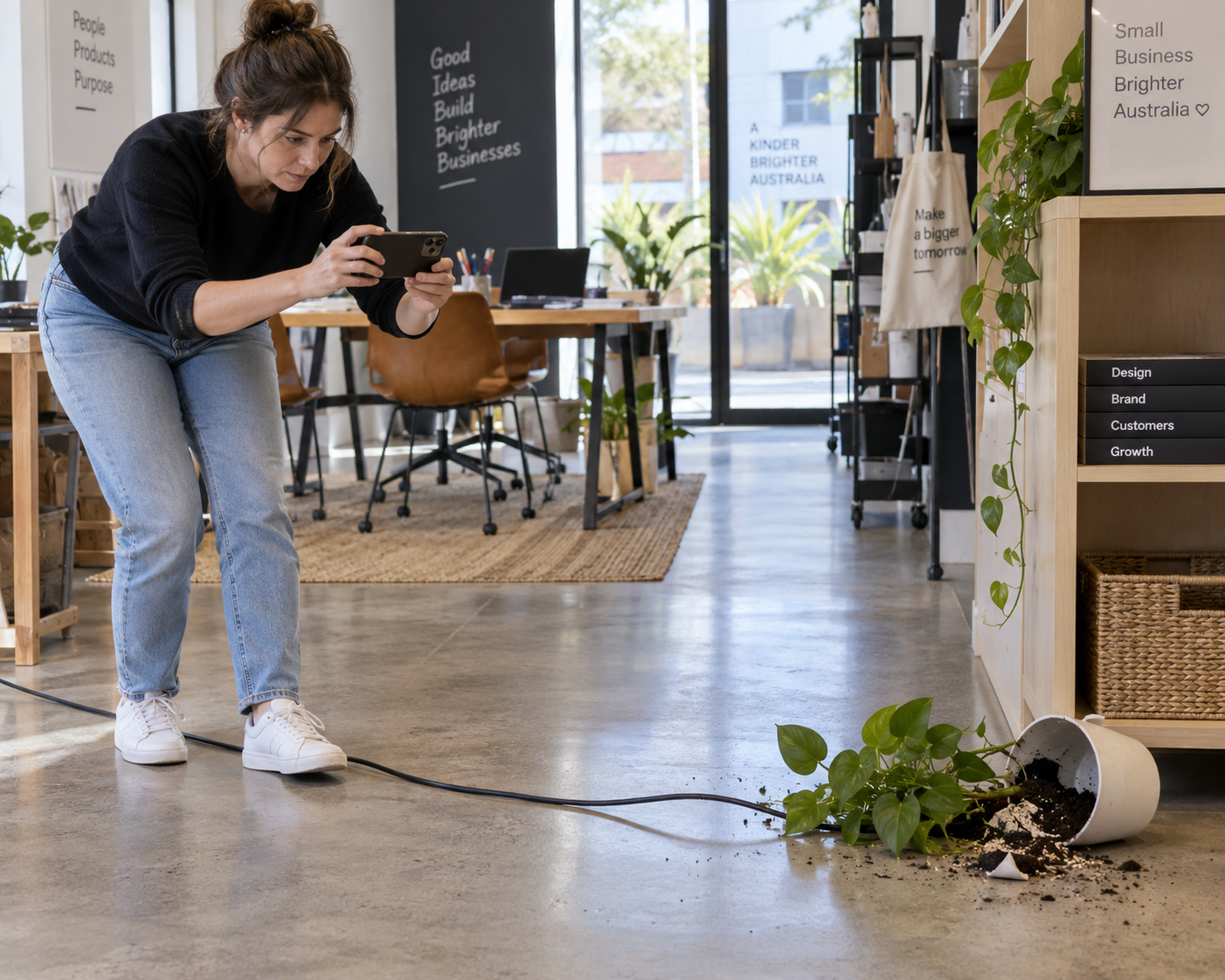
Physical conditions can change quickly after an incident. A spill may be cleaned, a cable moved or damaged equipment removed. Where it is safe and appropriate, photograph or video the scene before this happens. Take wide shots showing the overall area as well as close-ups of relevant details, such as:
spills or wet surfaces
cables, tools or equipment
damaged or uneven flooring
walkways and access points
barriers, cones or warning signs
visible property damage
Both perspectives can be useful. A close-up may show a cable on the floor, while a wider photograph shows its position relative to the walkway and any nearby signage.
Keep the original files and retain their date and time information where available. Avoid relying only on screenshots, cropped images or edited copies.
This evidence can be particularly relevant where the use of equipment is part of the work. For example, public liability insurance for photographers may respond to an eligible claim if lighting stands, cables or other photography equipment contribute to third-party injury or property damage, subject to the policy.
Document Any Reported Injury or Property Damage
Record what the affected person says was injured or damaged without attempting to diagnose an injury or assess its severity.
For an injury, note observable facts, what the person reports and any first aid or other assistance provided. Record who assisted and when, along with any ambulance or medical assistance requested.
For property damage, describe the damaged property and photograph any visible damage. Record identifying details such as the make or model where readily available.
Keep the record factual. Avoid statements about whether an injury is genuine, the value of the damage or who caused the incident.
Collect Witness Details and Separate Accounts
Record each witness’s full name and contact details while they are still available.
Where practical, ask witnesses to provide a short account of what they personally saw or heard. Note where they were positioned during the incident, as this can help establish what they actually observed.
Keep accounts separate so each person records their own recollection rather than developing a shared version of events. Preserve the original statements or notes with the incident documentation.
Preserve CCTV and Other Time-Sensitive Evidence
Check whether CCTV or another recording system may have captured the incident.
Promptly save relevant footage from your premises, especially if the system automatically overwrites older recordings. If several cameras cover the area, preserve footage from each relevant angle.
If the incident occurred at a client’s premises, venue or shared workspace, note whether any cameras may have captured the incident and ask the relevant party to preserve that footage before it is overwritten.
Keep relevant photographs or videos taken by employees, contractors or witnesses as well. Original files should be retained without editing or deleting material simply because it appears inconsistent with your version of events.
Keep Business Records Relevant to the Incident
Photographs and incident notes capture what happened at the time. Business records can fill in what was happening before it.
Depending on the circumstances, relevant records may include:
cleaning and inspection logs
maintenance and repair records
equipment servicing records
risk assessments or safety checks
job sheets and work orders
staff rosters or shift records
venue or site records
relevant procedures or instructions
earlier complaints, near misses or maintenance requests involving the same area or hazard
If a product is involved, retain relevant batch numbers, supplier information, invoices or purchase records.
For example, a cleaning record may show when an area was last inspected before a slip, while servicing records may establish the maintenance history of equipment alleged to have caused an injury. Keep existing records in their original form. Do not retrospectively alter them after the incident.
Save All Communications About the Incident
Keep relevant emails, text messages, letters and other communications from the affected person, witnesses, clients or venue operators. For telephone conversations, make a dated factual note recording who called and the main points discussed.
Also retain any later:
photographs
repair invoices or quotes
medical correspondence sent to you
reimbursement requests
compensation demands
letters of demand
Keep these records in chronological order to ensure a clear history of how the matter developed.
Avoid admitting liability, promising payment or agreeing to settle the matter before your insurer has had the opportunity to assess the circumstances.
Provide Your Documentation When Notifying Your Insurer
Good documentation has limited value if it remains scattered across phones, inboxes and paper files.
When notifying your insurer, gather all relevant materials about the incident. This may include the incident report, photographs, videos, witness accounts, CCTV footage, maintenance records and subsequent correspondence.
Notification requirements vary between policies, so check the wording rather than waiting for a formal legal demand. Some incidents or circumstances may need to be reported before a formal claim is made.
Provide the facts and relevant evidence rather than selecting only information that appears favourable to your position. This gives the insurer a clearer basis for assessing the matter. Documentation supports the assessment but does not determine whether a claim is covered. Coverage depends on the circumstances and the applicable policy terms, conditions, limits and exclusions.
The most useful incident records are created while the details are still fresh. Recording what happened, preserving evidence and keeping supporting business records and communications together can give your insurer a clearer factual basis for assessing an eligible Public Liability claim.
How soon after an incident should I start documenting it?
Start as soon as reasonably possible once any immediate safety or medical needs have been addressed. Early records are generally more useful because the conditions at the scene are less likely to have changed and the events are still fresh in the minds of the people involved.
What if there were no witnesses or CCTV?
Other evidence can still be relevant. Photographs, your incident notes, cleaning or maintenance records, staff rosters, work records and communications before or after the incident may help establish what happened. Preserve whatever information is available rather than assuming the absence of CCTV or witnesses means there is nothing useful to record.
Should I notify my insurer if no formal claim has been made yet?
Potentially. Your policy may require notification of an incident or circumstance that could reasonably lead to a claim, rather than only a formal compensation demand. Check the policy notification requirements and notify the insurer promptly where required. All claims remain subject to the policy terms, conditions, limits and exclusions.
Written by Team Sami & Reviewed by
John David
Insurance Manager | Sami Insurance
With over 40 years of experience across the global insurance and reinsurance landscape, John David is a seasoned leader dedicated to simplifying protection for the modern workforce. As the Insurance Manager at Sami Insurance, John combines deep technical underwriting expertise with a passion for the evolving Insurtech space. John works closely with the Sami team to provide freelancers and sole traders with insurance solutions that are radically simple, transparent, and cost-effective. By leveraging cutting-edge technology and a sharp eye for detail, he helps clients navigate complex risks with a friendly, human-centric approach.
You finish photographing a wedding, but a storage failure corrupts part of the shoot and important images cannot be delivered. At another job, a guest trips over a lighting cable and injures their wrist.
Freelance graphic designers can face two different types of business risk. A client may allege that a design error, missed specification or copyright issue caused financial loss.
As a yoga instructor, you make professional judgements every time you teach. You decide how to cue alignment, modify poses, supervise students and structure a class from one movement to the next.





.svg) The Sami Team
The Sami Team